AD

Showing posts with label Training. Show all posts

Saturday, April 2, 2016

Preparation for Plyometric Training
Preparation for Plyometric Training
http://the4powerway.blogspot.com/

Plyometric exercises should be undertaken only once an adequate strength base has
been developed. Most sources define an adequate strength base for lower body plyometrics
as the ability to squat or leg press 1.5 to 2.0 times your body weight for one maximum
repetition. For upper body plyometrics, larger athletes (weight greater than 115 kg or 250
lbs.) should be able to bench press their body weight and athletes weighing less than 115
kg (250 lbs) should be able to bench press 1.5 times their body weight.

Plyometric training should never be undertaken if you
have any leg, hip, arm, or shoulder injury.


Safety in Plyometric Training

 
Several steps can be taken to ensure that plyometrics training is safe. These
measures include using an appropriate surface, footwear, and equipment, and proper
technique.


Surface

Plyometrics should not be performed on hard surfaces such as concrete or steel, nor
should they be performed on soft surfaces such as sand. The best surface is a grass
field, followed by artificial turf or wrestling mats. Wrestling mats should not be
too thick (> 15 cm) since they will increase the time in the amortization phase. The stored
energy gained during the lengthening phase will be lost, and this will defeat the purpose of
plyometric training.


Footwear


Recommended shoes are those that provide ankle and arch support, lateral stability,
and have a wide, non-slip sole.

Equipment

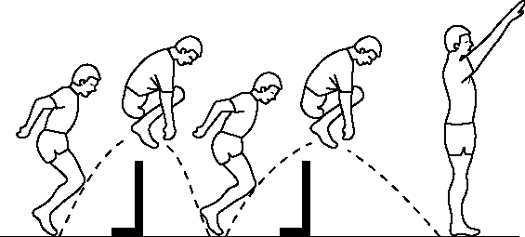
Boxes that are used for in-depth or box jumps should have a non-slip top and should
never exceed a height of 1.2 m (0.5 - 0.75 m is recommended: 1.5 to 2.5 ft. and less than 4
ft.).
Medicine balls are commonly used for many of the exercises. This is a ball that
weighs no more than 10% of your typical training weight. For example, if you regularly
train with a 200 pound bench press, then the medicine ball you use should be no more than
20 lbs. These balls can be covered with leather, plastic, rubber, or any type of fabric.

Technique

As with other exercises, attention should be paid to proper technique. For example,
when performing lunges, the knee angle should not exceed 90°. Any movement beyond
this angle will place undue stress on knee cartilage and ligaments. Keeping the knee
directly over and in line with the big toe will help maintain technique. The step should be
straight out, not to the side. The shoulders should always be over the knees during landing
when performing in-depth jumps.
Fatigue from high-volume training can compromise technique and result in injury.
When technique begins to fail, it is time to stop the exercise and rest.


Wednesday, March 23, 2016

Open Water Training

Open Water Training

There is no substitute for ocean or lake swimming. Training in open water will force
you to swim straight and develop a cycle of breathing that allows you to look forward in
order to navigate. This is an essential skill for operational swimming. Group swims in open
water are an excellent way to maintain fitness and should be used extensively in SEAL
training programs. Open water training will maximize the training effect of using fins.
For operational open water swimming,
the sidestroke with a flutterkick
is superior to freestyle.
In rough open water and under operational circumstances you may want to combine
a scissor kick with a sidestroke pulling technique to maximize your navigational ability and
watch for breaking waves. However, sculling is as important in the sidestroke as it is in
freestyle. Both arms should be used to incorporate sculling motions and to stabilize the
swimmer's trunk while the kick provides the main thrust. There are stroke efficiency issues
with the sidestroke just as there are in other swimming strokes. Stroke coaching is
invaluable in developing good technique.

Water Temperature Issues

Cold water is an issue to be addressed by SEALs training in open water. Although
the work of swimming generates heat, there is heat loss created by movement of the
swimmer into new “unheated” cold water. Thus, open water swimming may require
various combinations of passive thermal protective gear, in particular, wet suits. The three
determinants for passive thermal protection are:
  • Temperature
  • Length of the swim
  • Effort level
It is important to remember that wet suits operate by allowing the body heat to be
transferred to a layer of water caught between the body and the neoprene material of the
suit. Convective heat loss from the swimmer's body is greatly reduced by this mechanism
and as a result, swimming at a high effort while wearing a wet suit allows the swimmer to
generate and retain heat. Guidelines have been developed for training and are presented in
this section.
Research has established some known “bench mark” facts about operating in a cold
water environment. In very cold water (below 40° F), the unprotected swimmer loses heat
faster than an immobile person immersed in the same cold water. Heat generation simply
does not keep up with losses. The immobile person warms the cold water immediately
around his body thereby limiting total heat loss. However, in moderately cold water
(around 68° F), an elite class swimmer may stay active, and the heat generated by
swimming keeps pace with overall losses (although the swimmer may develop cold feet
and hands). In this situation, the active swimmer outperforms the immobile person with
respect to maintenance of core body temperature. Currently we do not know the crossover
temperature point or the water temperature at which it is better to remain stationary than
active in the water for thermal balance.
Passive thermal protection modifies this balance by reducing the convective
component of heat loss. As a result, a swimmer may extend training durations beyond those
possible without
passive thermal protection. Diving medicine specialists at BUDS have
developed guidelines for use of passive thermal protection during training in cold water
environments. Note that Table 5-2 is limited to high energy swims at a set distance of 2
miles.
 

Wednesday, March 16, 2016

Flexibility Training Methods

Flexibility Training Methods

There are several training methods used to develop flexibility; however, most fall
under the following general categories:
  • Dynamic
  • Static
  • Ballistic
  • Proprioceptive neuromuscular facilitation (PNF)

Dynamic Stretching

Dynamic stretching (sometimes referred to as active stretching) consists of
controlled movements which increase in range and/or speed so that you gradually reach
your full range and speed of movement (e.g., slow, controlled leg swings or kicks,
controlled arm swings, back bends). This type of stretching often mimics the activity that
is to be performed and prepares the muscles for that activity.
There is some controversy surrounding the effectiveness of dynamic stretching and
its role in the development of flexibility. Some experts believe that the short, intermittent
movements involved in this type of stretching activate the stretch reflex and cause the
stretched muscle to contract. Others maintain that dynamic stretching is beneficial for
quick, explosive activities like gymnastics or martial arts. However, in general, dynamic
stretching should not be used to develop static flexibility or long-standing changes in range
of motion. If used at all, dynamic stretching functions best before exercise to enhance
performance. This type of stretch is often performed after a warm up and prior to an
exercise session in anticipation of a particular activity. Dynamic stretches should mimic the
activity that is to be performed.

Static Stretching

Static stretching (sometimes referred to as passive stretching) develops static
flexibility and uses slow, controlled movements through a full range of motion. This type
of stretch is performed by holding a position using a part of the body, the assistance of a
partner, or some other apparatus such as a pole or the floor (e.g., lifting one leg up and
holding it with the hand, the splits). Slow, static stretching helps relieve muscle spasms due
to exercise, and is used for cooling down after a workout to reduce muscle fatigue and
soreness.

Ballistic Stretching

Ballistic stretching uses the momentum of the body or a limb to force a stretch past
the normal range of motion and then return to the starting position. Ballistic stretching
incorporates bouncing or jerky movements and should not be confused with dynamic
stretching. An example of a ballistic stretch would be bouncing down to touch toes or using
the momentum of the torso to twist the body. Uncontrolled arms swings in which the arms
are thrown backward and then bounce back to the starting position are also an example.
This type of stretching does not contribute to flexibility. Instead, the repeated activation of
he stretch reflex causes muscles to contract which can lead to injury. This type of
stretching is not recommended.
 

PNF Stretching

Proprioceptive neuromuscular facilitation (PNF) stretching is considered an
advanced stretching technique. It is used extensively by physical therapists or when high
degrees of both passive and dynamic flexibility are required for performance (e.g., martial
arts, ballet, gymnastics, kick-boxing). There are several PNF techniques, but generally,
PNF consists of a passive stretch, followed by an isometric contraction, which is then
followed by another stretch (static or dynamic). By combining passive stretching with
isometric contractions (a contraction in which there is no change in muscle length or joint
movement) with a partner or object for resistance, PNF uses the stretch reflex and
lengthening reaction to achieve a greater range of motion. As described in the section
above, when a muscle is slowly stretched and held, the resulting tension triggers the
lengthening reaction which prevents the stretched muscle fibers from contracting. When
this stretched muscle is then isometrically contracted, the following happens:
  • During an isometric contraction, some fibers will contract, but others will
           stretch even further. When the contraction is stopped, the contracted fibers
           return to their starting position, while the stretched fibers retain their
           stretched position (due to muscle spindle accommodation) and are able to
           lengthen even further.
 

  • The increased tension within the muscles generated by an isometric contraction
            activates the GTO which triggers the lengthening reaction, and inhibits
            further contraction. When the isometric contraction is stopped, the muscle is
            still inhibited from further contraction and able to lengthen further.
The final stretch, which follows isometric contraction, takes advantage of the
muscle's ability to elongate further, and allows the muscle, tendon, and sense organs to
adapt to greater lengths.

It is best to have a partner help when using PNF techniques.

A common PNF technique is referred to as the “contract-relax method”.
Instructions for and a pictorial representation of this method are provided in Figure 7-2.
This technique uses passive stretch and isometric contractions, followed by muscle
relaxation and passive stretching to the new range of motion. For example, if you are
stretching your hamstrings, you first passively take the stretch to the point of tightness and
hold. Then you isometrically contract the hamstrings by using this muscle to apply force
against an object or partner (See Figure 7-2). Following the contraction, the muscle is
allowed to relax and the muscle is then passively stretched and held. Current
recommendations suggest performing this technique with one to five repetitions, but like
weight training, it needs to be done no more than three to five times a week.
 
 
It is interesting to note that many stretches (including some of those illustrated in
this chapter) can be performed statically, dynamically, or using PNF, depending on the
goals of a stretching program.


Monday, March 7, 2016

Interval Training

Interval Training

 
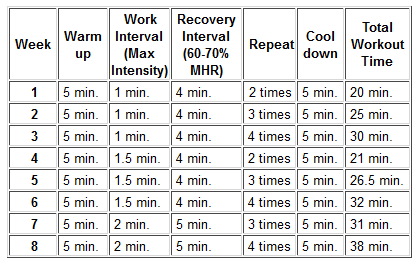
Exercise bouts are alternated with rest or relief periods. Relief periods usually
involve mild to light exercise. Generally, in swimming no exercise is performed during the
relief periods. The duration, intensity, and number (repetitions) of exercise bouts and the
length and type of relief intervals are chosen to suit specific exercise performance
requirements. Interval training allows you to exercise at a higher intensity than you could

Sprint Training

Sprint training helps develop speed and increase muscle strength. Individuals are
required to sprint repeatedly at maximum speed while allowing for complete recovery
between sprints. In general, 6 seconds are needed to go from a stationary position to
maximum speed. For a runner this would mean running 55 to 60 meters to reach that
maximum speed.

Interval Sprints

This method involves alternately sprinting for 45 to 50 meters and jogging for 55 to
60 meters while covering a distance of about 3 miles. Interval sprinting helps to develop
aerobic capacity.

Acceleration Sprints

Acceleration sprint training develops speed and strength. Running speed is
gradually increased from jogging to striding to sprinting, followed by a recovery walk. This
sequence is repeated. Intervals may range from 50 to 100 meters each. For example: 50
meters jogging, 50 meters striding, 50 meters sprinting and 50 meters walking.

Fartlek or Speed Play

The work Fartlek means “speed play” in Swedish. It involves running at fast and
slow speeds on both level and hilly courses. Unlike interval training, the fartlek form of
training does not involve specific exercise and rest periods; you do it as desired. For
example, you may say to your buddy “I’ll race you to the next stop sign”, and you would
both run as fast as you can to that point. You may run at a slower pace for a few minutes,
and then run fast again for as long as you want. In other words, it is a speed workout without
structure. As such, it is well suited to general conditioning and provides variety to
workouts.

Continuous Exercise Training

This type of training is needed to build endurance for activities such as distance
running and open ocean swimming. Exercise is performed with distance in mind and may
be done at a slow or a fast pace. The aerobic system is the main energy source for this type
of activity. Specific training requirements for endurance training in running and swimming
will be discussed in Chapters 4 and 5.
The Navy SEAL Physical Fitness Guide 19

Repetition Running

This method is similar to interval training, but unlike interval training, the length of
the intervals are longer and usually range from 0.5 to 2.0 miles. Recovery between intervals
lasts until the heart rate is under 120 beats per minute, or within 60% of your estimated Max
HR.

Tuesday, February 2, 2016

The Importance Of Triathlon Training

By Ann Watson


Watching athletics is not only admirable but also interesting. Athletics is a single sport that is composed of different events. This type of sport involves less team work but more of individualism which is not the case in many other type of sports. It is very rewarding especially for the winners. Triathlon is a type of competition in which three events are performed. These events are swimming, cycling and running. Triathlon Training gives the participant the required skills, energy and the experience in order to win the race.

Swimming in many cases is performed as the first event during the competition. The event is in normal cases done in open waters such as rivers and lakes. One needs to be a good swimmer because at times the water is very deep and resting period may be limited. The buoyancy is at times contributed by the type of the clothing one wears during competition day. Swim suits are the most appropriate because one is also able to tolerate the changing water temperatures.

Cycling is usually the second event to be performed during the day of competition. The longest distance is covered during it and therefore one needs to prepare properly so as to complete the race. It is very important to ensure that the bicycle is mechanically okay during the day of competition. Also carry with you the drinking water mainly in a bottle. Then make sure that you bicycle is fitted with clip less pedals.

Running is actually the next event to be performed. This means that the participants are very tired after going through the other events. In most cases the one who has done the most appropriate practice wins. The experience is also an important factor that is required for one to win. Ensure that you develop the speed that is best for you with which you can complete the race. Feed on a good diet during training.

Muscles develop the right enduring power which is very important in order to put up with the fatigue. As a result of training the muscles that are developed makes the body hard and therefore reducing the chances of being injured during the competition. They also cover delicate rejoins such as the joints hence the chances of the injury occurring are very minimal.

The training helps one develop the right posture which is mandatory for a good performance. This is brought about as a result of good form of the muscles. When a lot of training is done, there are too many fibers that develop. They reduce the time needed for the muscle to be broken down a condition that leads to fatigue.

Good results in completion do not only occur as a result of strong muscles but also on how efficient the job is done. Training increases the efficiency therefore increasing the chances of winning the race. The materials the one must have during the day of competition are, swim suit, bicycle, clip less pedals, water bottle, cycling short, a nice pair of running shoes and the goggles.

Resting period should be included in the in the training schedule, so as to enhance the efficiency. Like after meals it is very important to rest to provide the enough time for the digestion to take place. A good participant should be mentally prepared before the day of the competition


About the Author:


Friday, January 29, 2016

Benefits Of Dry Needling Pennsylvania

By Robert Edwards


If you're in pain, you want relief. General practitioners can diagnose the problem and, probably, prescribe a painkiller. Unfortunately, this kind of temporary fix can help immediate suffering but does little to heal or promote long-lasting improvement. What can be long-lasting is an addiction to prescription medicine. For this reason, people with chronic pain or muscle injuries may try alternative methods. Dry needling Pennsylvania is one therapy gaining in popularity.

The therapy, developed over forty years ago, is on the surface a combination of acupuncture and western medicine. The true philosophy is different from the ancient Chinese therapy, but for the laymen the similarities help to gain an understanding of what to expect. Needles are inserted through the skin in a manner similar to acupuncture. However, the target is not an energy meridian but a particular area of deep muscle tissue.

Filiform needles are used in many cases. These are solid and usually slightly larger in diameter than an acupuncture tool. In cases where an injection of corticosteroids or other therapeutic substance is called for, hollow hypodermic needles are used. The needle allows the therapist to pinpoint the target and stimulate a muscle or a trigger point.

Muscles sometimes knot up, as their tissue contracts and fails to release. This can be in response to tension over an extended period of time or to a sudden stress, as in a sports injury. This contraction causes pain at the immediate site and possibly in other areas of the body. The added strain can affect skeletal alignment and other muscles or connective tissue. Massage may help muscles to relax, but if manual manipulation is not enough, further measures may be called for.

With a needle, a skillful therapist can reach deeper into tissues than massage can go. The instrument allows precise stimulation, which can release a knotted muscle. Both athletes and sedentary patients experience an increase in muscle tone and flexibility with needling. As muscles relax, the tissue also lengthens and normal movement may be restored.

Most people don't feel the instruments passing through the skin. However, when the muscle itself is probed, there can be minor pain. This is generally in the form of cramping, as the muscle reacts to the stimulation. Soreness and bruising sometimes result, but these are usually not serious and easily relieved by soaking in an Epsom salts bath or applying ice to the area. Physical activity is generally good for recovery, although it should be light exercise rather than anything intense.

The average course of treatment is two to four sessions. This treatment is used extensively in sports medicine and in pain management. It is considered a very safe and non-invasive way to provide relief and promote healing. Side effects may be similar to those of deep tissue massage, mainly tiredness and soreness.

Look online or in the local phone directory for clinics which offer this therapy, which is growing in popularity. The staff will be able to explain both the purpose and the practical aspects of therapy. Dry needling holds out hope for those who suffer chronic pain or who have suffered an injury while engaging in their favorite sport. Just think about living without back pain or once again being able to exercise as you wish.


About the Author: