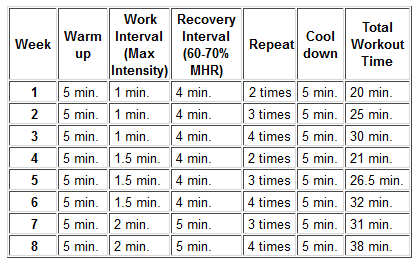
Exercise bouts are alternated with rest or relief periods. Relief periods usually
involve mild to light exercise. Generally, in swimming no exercise is performed during the
relief periods. The duration, intensity, and number (repetitions) of exercise bouts and the
length and type of relief intervals are chosen to suit specific exercise performance
requirements. Interval training allows you to exercise at a higher intensity than you could
Sprint Training
Sprint training helps develop speed and increase muscle strength. Individuals are
required to sprint repeatedly at maximum speed while allowing for complete recovery
between sprints. In general, 6 seconds are needed to go from a stationary position to
maximum speed. For a runner this would mean running 55 to 60 meters to reach that
maximum speed.
Interval Sprints
This method involves alternately sprinting for 45 to 50 meters and jogging for 55 to
60 meters while covering a distance of about 3 miles. Interval sprinting helps to develop
aerobic capacity.
Acceleration Sprints
Acceleration sprint training develops speed and strength. Running speed is
gradually increased from jogging to striding to sprinting, followed by a recovery walk. This
sequence is repeated. Intervals may range from 50 to 100 meters each. For example: 50
meters jogging, 50 meters striding, 50 meters sprinting and 50 meters walking.
Fartlek or Speed Play
The work Fartlek means “speed play” in Swedish. It involves running at fast and
slow speeds on both level and hilly courses. Unlike interval training, the fartlek form of
training does not involve specific exercise and rest periods; you do it as desired. For
example, you may say to your buddy “I’ll race you to the next stop sign”, and you would
both run as fast as you can to that point. You may run at a slower pace for a few minutes,
and then run fast again for as long as you want. In other words, it is a speed workout without
structure. As such, it is well suited to general conditioning and provides variety to
workouts.
Continuous Exercise Training
This type of training is needed to build endurance for activities such as distance
running and open ocean swimming. Exercise is performed with distance in mind and may
be done at a slow or a fast pace. The aerobic system is the main energy source for this type
of activity. Specific training requirements for endurance training in running and swimming
will be discussed in Chapters 4 and 5.
The Navy SEAL Physical Fitness Guide 19
Repetition Running
This method is similar to interval training, but unlike interval training, the length of
the intervals are longer and usually range from 0.5 to 2.0 miles. Recovery between intervals
lasts until the heart rate is under 120 beats per minute, or within 60% of your estimated Max
HR.